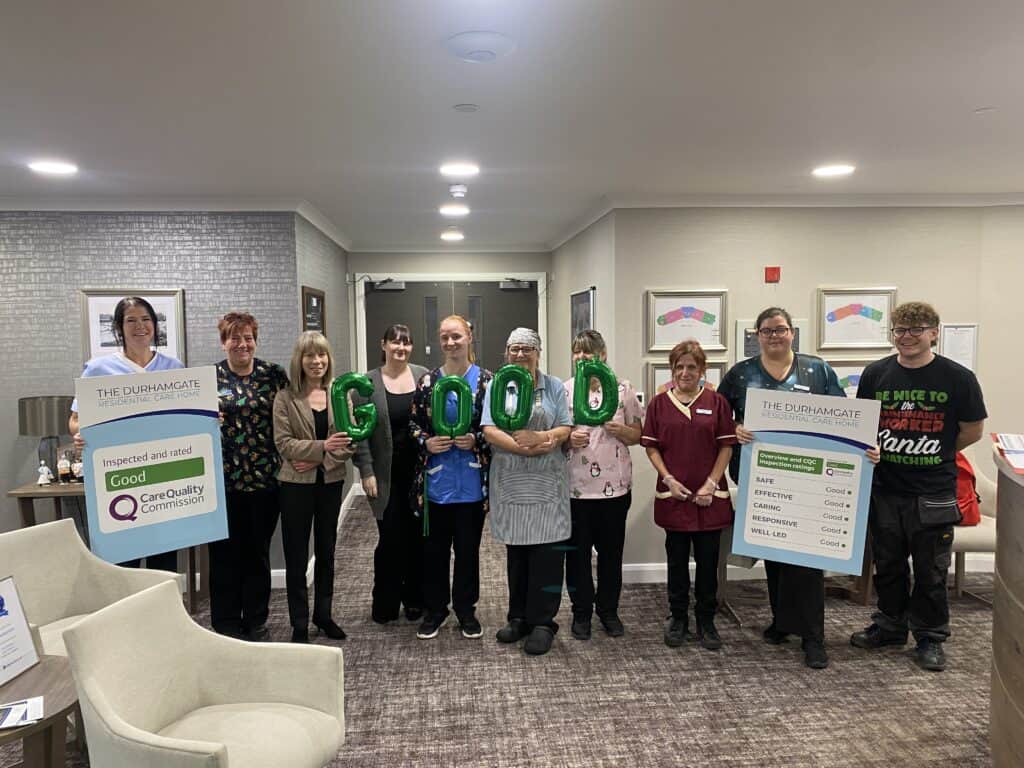
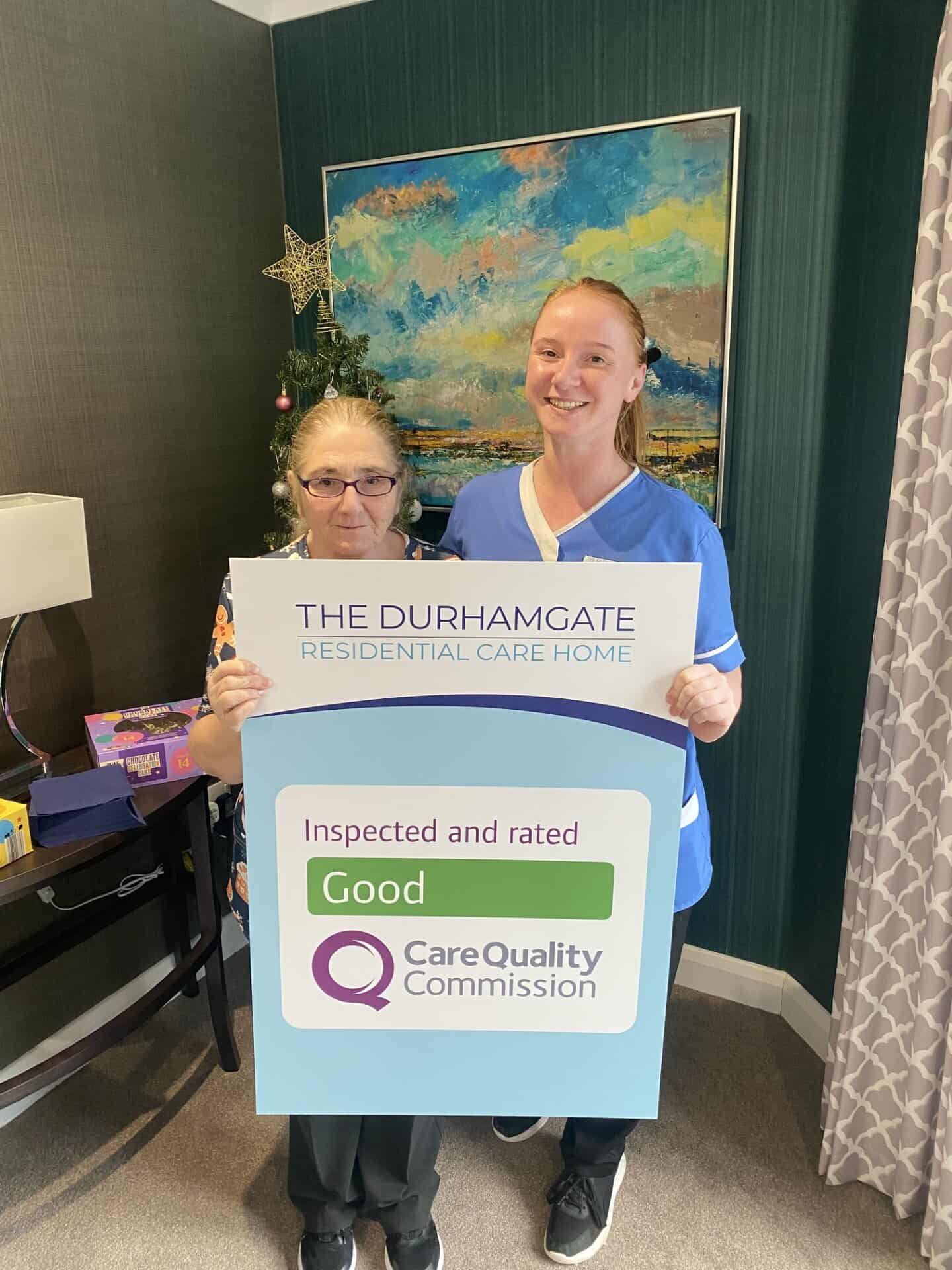
The DurhamGate care home, Spennymoor, County Durham, has been rated ‘Good’ in all areas following their first CQC (Care Quality Commission) inspection.
During the visit, CQC inspectors observed the residents’ experience in the home. They spoke to several residents, their families, and staff members, seeking feedback on the service the care home offers.
The CQC praised The DurhamGate for its ‘friendly, open and transparent’ atmosphere, stating that the residential care home promoted a ‘positive, relaxed, open culture that was compassionate and caring.’
Inspectors were impressed with the ‘person-centred care’, stating that residents and relatives ‘felt listened to and consulted when planning and agreeing how care and support should be provided’ and ‘supported people to have an active life in line with their preferences and choices about how they liked to spend their time.
Upon speaking to residents, inspectors reported that ‘staff were caring, kind and supportive’ and ‘treated people with great kindness, empathy and compassion’, with residents commenting, “I am well cared for” and “Staff are lovely here, they are very caring.”
The DurhamGate was commended for its positive ethos ‘where people were at the heart of the service’ and staff ‘supported people to manage their health and wellbeing to fully maximise their independence, choice and control.’ The team at The DurhamGate were praised for the ‘shared vision, strategy and culture’ which ‘focused on continuous learning, innovation and improvement’ by enabling people to share feedback and ideas and ‘encouraged creative ways of delivering equality of experience, outcome and quality of life for people’.
 Management and leadership at the home was also praised in the report, noting that ‘leaders had the skills, knowledge, experience and credibility to lead effectively’ and that they did so with ‘integrity, openness and honesty’.
The facilities of the home also received a special mention, noting that ‘the environment was exceptionally well-designed for people’s comfort and well-being.”
Karen Johnson, General Manager at The DurhamGate, said, ‘We are delighted to receive a ‘good’ rating from the CQC for our first inspection at The DurhamGate. This achievement reflects the hard work and genuine care that our entire team demonstrates every day.
‘We’d like to extend our gratitude to all our wonderful residents and their families for being such an important part of the The DurhamGate community.’
You can read The DurhamGate’s report on the CQC website.
 December 8, 2025
Attendance Allowance in Care Homes: Eligibility and How to Claim
on Care Guides, NewsMoving into a care home is a significant life change and navigating the financial landscape can often feel overwhelming. One of the most common questions we hear from families is: “Can we still claim Attendance Allowance?”
The answer depends on your funding arrangements. This guide covers the essential rules, current rates, and how to apply, with facts directly sourced from government and charitable experts.
What is Attendance Allowance?
Attendance Allowance is a tax-free, non-means-tested benefit for people over State Pension age who need help with personal care or supervision due to a disability or illness. This means your savings and income do not affect your eligibility. According to GOV.UK, it is designed to help with the extra costs of having a long-term health condition.
Which Medical Conditions Qualify?
There isn’t a fixed list of “approved” conditions. Eligibility is based on how your condition affects your daily life, not the condition itself.
As Age UK explains, you can claim if you have a physical disability (like blindness), a mental disability (including learning difficulties), or both, provided your disability is severe enough that you need help caring for yourself.
Common conditions that often lead to a successful claim include:
- Dementia and Alzheimer’s disease
- Parkinson’s disease
- Arthritis and mobility issues
- Sensory impairments (sight or hearing loss)
- Stroke complications
A Care Needs Test will be carried out. To qualify, you generally must have needed help for at least 6 months (unless you are terminally ill). You do not need to receive help to claim; you just need to show that you reasonably need it for tasks like washing, dressing, or staying safe.
Attendance Allowance in a Care Home: The Rules
Your entitlement changes depending on who pays for your care. Here are the two main scenarios:
Scenario 1: You Are Self-Funding Your Care
If you pay for all your own care home fees, you are usually entitled to continue receiving Attendance Allowance.
Because you are covering the cost of your accommodation and care, the government views this similarly to living in your own home.
NHS Advice: Even if you are self-funding, you might receive “NHS-funded nursing care” (FNC) payments to cover the nursing portion of your fees. The NHS confirms that receiving FNC does not stop you from claiming Attendance Allowance. Please note, as residential care homes, FNC would not apply to our care homes.
Scenario 2: The Local Authority Pays for Your Care
If your local council pays for your care home fees, your Attendance Allowance will usually stop after the first 28 days of your residency.
This is because the benefit is designed to help pay for care costs. If the council is already paying for that care, receiving the allowance is viewed as “double funding”.
What About Respite Care?
Many families use care homes for short-term respite care.
- Self-Funded Respite: If you pay for your own respite care, your Attendance Allowance continues uninterrupted, regardless of the length of stay.
- The 28-Day Rule: If your stay is funded by the local authority or NHS, your Attendance Allowance continues for the first 28 days. It stops if you stay longer.
- The “Linking” Rule: It is crucial to track your days. Citizens Advice warns that if you go into a care home for respite, return home, and then go back into care within 28 days, these periods are “linked” (added together). If the total time in care exceeds 28 days, your benefit may be paused.
Current Rates (2025/2026)
The amount you receive depends on the level of care you need. The rates for the 2025/2026 tax year are:
- Lower Rate: £73.90 per week – for those who need frequent help or constant supervision during the day, or supervision at night.
- Higher Rate: £110.40 per week – for those who need help or supervision during the day and night, or if you are terminally ill.
How to Apply for Attendance Allowance
Applying can seem daunting, but support is available.
- Get the Form: You need form AA1A.
- By Phone: Marie Curie advises calling the helpline at 0800 731 0122 (Textphone: 0800 731 0317). Calling is recommended because your claim date (and potential backdated payment) starts from the date of your call.
- Online: You can download the AA1Aform from GOV.UK.
- Fill It In: Be detailed. Describe the difficulty you face, not just the condition. Guidance on how to fill the form is provided.
- Submit: Send the completed form to “Freepost DWP Attendance Allowance” (you don’t need a postcode or a stamp).
Need Help Navigating Care Funding? We’re Here to Help.
Understanding Attendance Allowance and care home funding can be complex. Our team is well-versed in these matters and can offer guidance to help you and your family understand your options.
Contact our friendly advisors today for a confidential chat.
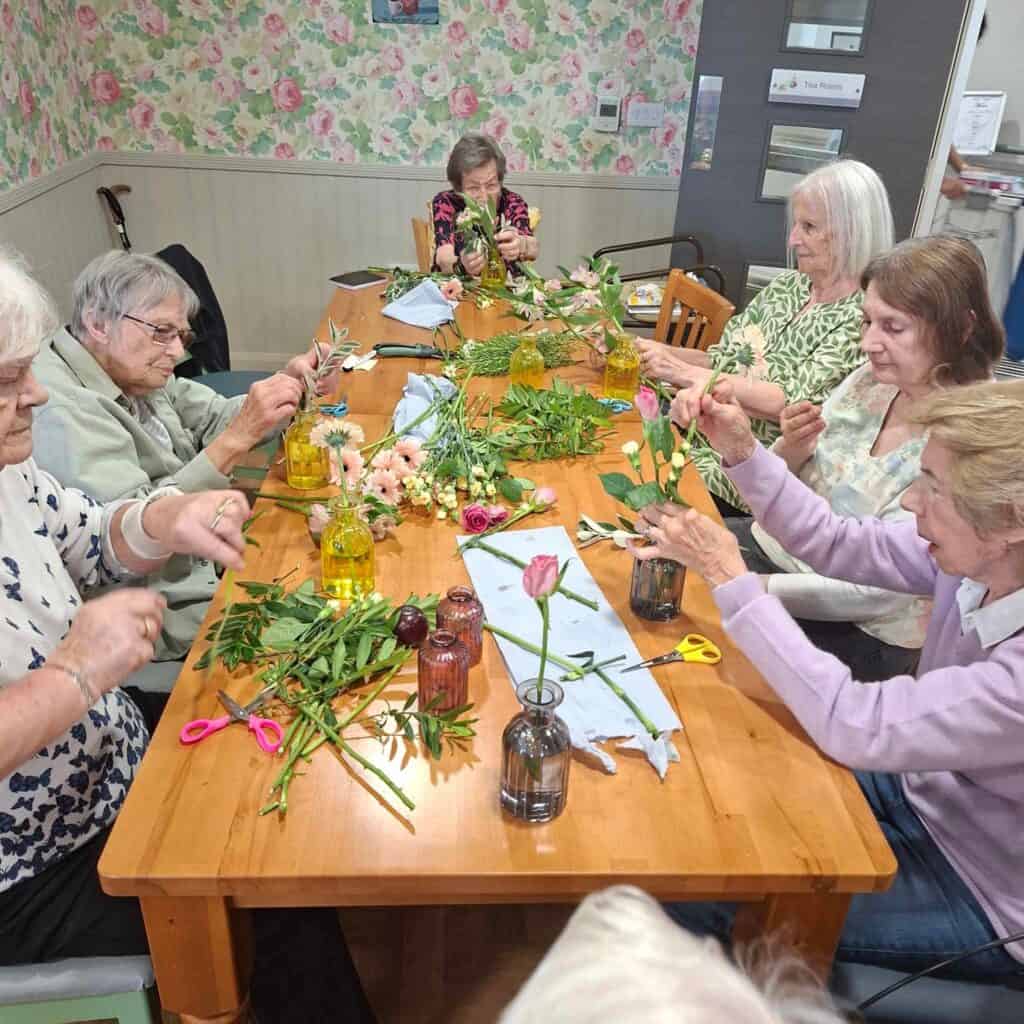
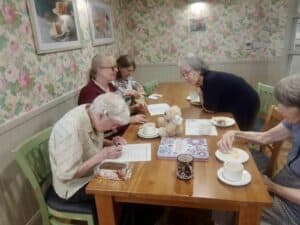
Residents at Weavers Court Care home, enjoyed a fabulous afternoon of crafts, colouring and mindful artwork. Free drawing, interaction between themselves and with staff on a
variety of different subjects to draw and colour in produced a great variety of creative art and interpretation.
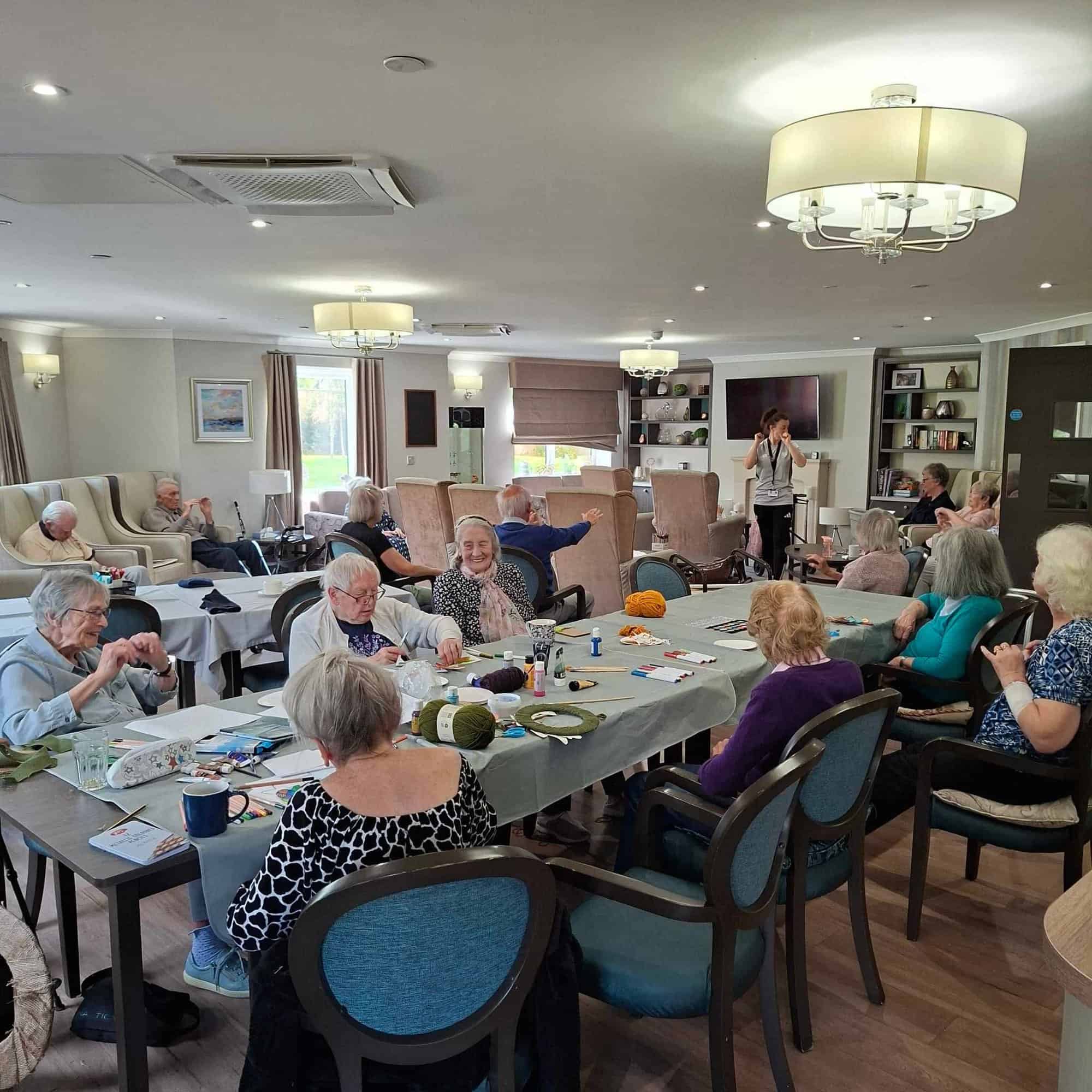
Commenting on this fun filled afternoon that had residents (and staff!) thoroughly engaged, Lifestyle and Activities Assistant, Julie Porter said;
“This is a wonderful way of stimulating communication, enhancing a sense of shared enjoyment and purpose as well as promoting wellbeing.”
The afternoon was an enormous success and only one of many occasions that the famous care home; renowned for its hospitality and engagement.
 October 9, 2025
John & Sue celebrate another wedding anniversary at Weavers Court
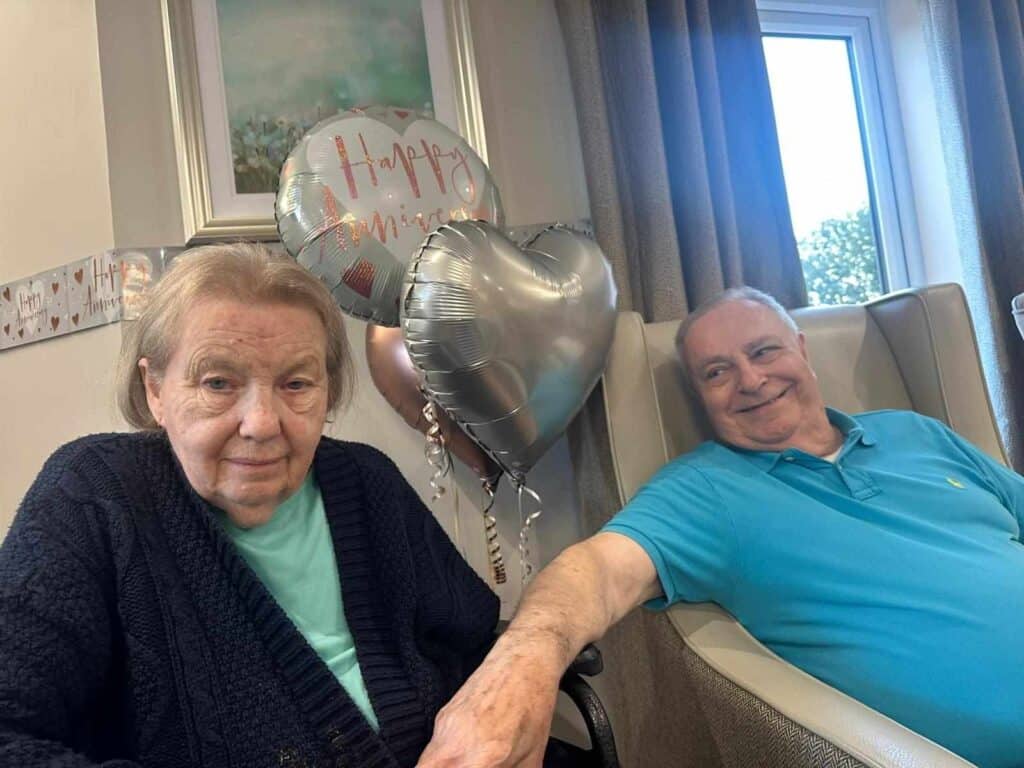
on News, Weavers CourtHusband and Wife , John and Sue Nelson celebrated yet another wedding anniversary at the famous Weavers Court Care Home. The lovely couple have been residents at Weavers Court for almost 2 years now.
 Previously enjoying a ride in the Director’s MGB sports car, a throwback to their own younger years when they used to tour in their own MG; this year they celebrated in style with friends and family in the home.
In typical Weavers Court hospitality, a party was thrown, cakes were baked, candles lit and congratulations offered to John and Sue , who celebrated their 58th anniversary in style.
 May 16, 2025
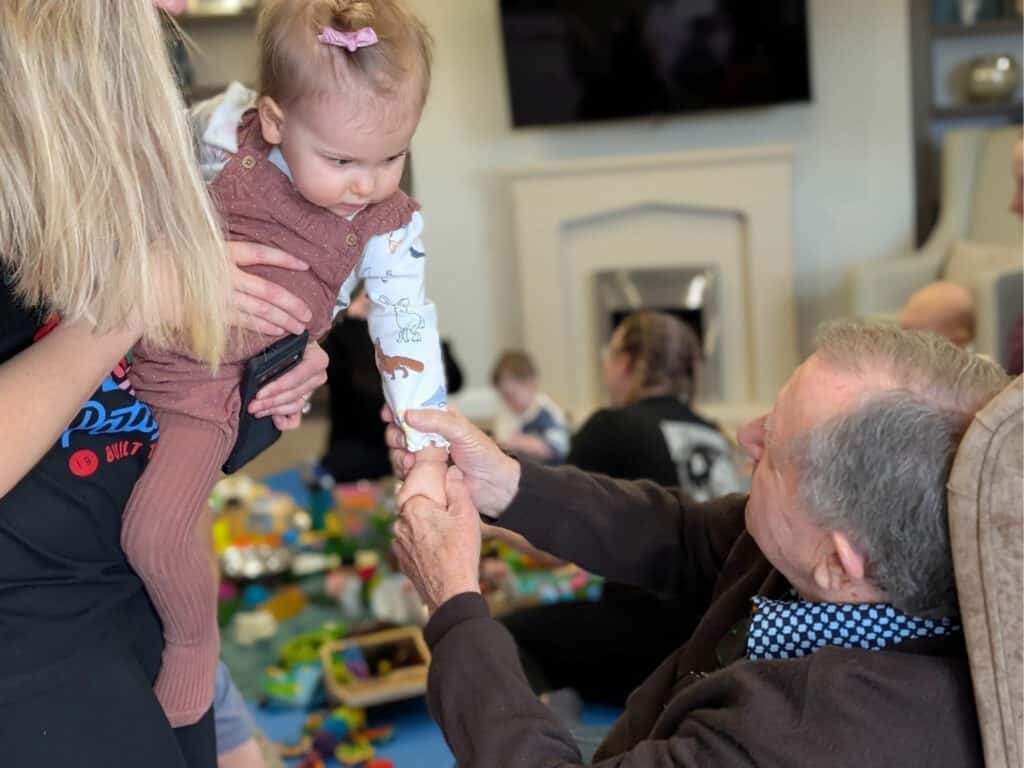
Expert shares the benefits of intergenerational activities as babies ‘bring joy’ to County Durham care home residents
on News, The DurhamGateA care home in Spennymoor has partnered with local baby development class, Lullababy Durham, to host monthly sessions for its residents.
Intergenerational activities bring together younger and older generations to create meaningful experiences that benefit all involved. The DurhamGate Care Home hosts regular baby and toddler sessions designed to bring generations together through music, movement, and shared experiences.
Providing care, community, and connection, the initiative Lullababy Durham, led by Cheryl Armstrong, delivers interactive sessions that encourage residents to get involved, waving ribbons, singing along and dancing with the little ones.
With a huge impact on both older people and young families, Lisa Tones, Care Manager at DurhamGate, explains four benefits of intergenerational activities:
Boosts mental and emotional well-being
“Intergenerational activities often spark conversations, unlock memories, and create connection. For older adults, these activities can improve mental and emotional well-being by boosting their mood and keeping their minds active.
It’s incredibly heartwarming to see how our residents light up during these sessions. The feedback from these sessions has been fantastic, which is why we’ve made them a regular event so that the positive impact is long-lasting, not just a one-off.”
Promotes meaningful learning and interaction
“What’s particularly special about these visits is the mutual exchange of experiences and skills. While the babies benefit from sensory play and new stimuli, older people enjoy meaningful interactions that remind them of their own parenting days.
They also get the chance to share advice and stories with the parents, creating a three-way learning experience. Intergenerational sessions like this aren’t just heartwarming, they’re a powerful way to pass on knowledge across generations.”
Connecting with the community
“Connection is key, especially later in life. Intergenerational activities provide a great opportunity to socialise with others outside of their own age group, helping older adults feel valued and connected to the wider community.
For some of our residents, especially those whose families live further away and aren’t able to visit regularly, it’s like a second family. The visits from the babies and parents bring so much happiness to the residents and have led to lifelong bonds.”
Encourages physical activity
“As we get older, mobility can become more limited and staying active can become more challenging, so incorporating movement into fun activities is a great way to support physical wellbeing.
Activities such as dancing, light movement, and games can be adapted so everyone can take part, regardless of age or ability. It’s a fun and inclusive way to keep moving, and many of our residents don’t even realise they’re exercising.”
Cheryl Armstrong, Class Leader at Lullababy Durham comments,
“I started this class to connect generations. The residents don’t always have family nearby, so this gives them a chance to see and interact with babies each week. It’s gentle exercise and emotional connection all rolled into one.”
The classes also offer support for new parents, who describe the care home in Durham as a warm, welcoming space. The mums always comment on how lovely the home is,” Cheryl adds. “It’s become a real community. Residents and parents now know each other by name. It’s magic.”
Resident at DurhamGate Mike Holmes added,
“My late wife and I fostered many children and babies, and it brings me so much joy to still get to spend time with youngsters. It really brightens my day.”
Intergenerational activities are a key part of life at DurhamGate. Alongside the regular Lullababy sessions, the care home has also recently welcomed pupils from King Street Primary School to spend time with residents.
 November 30, 2024
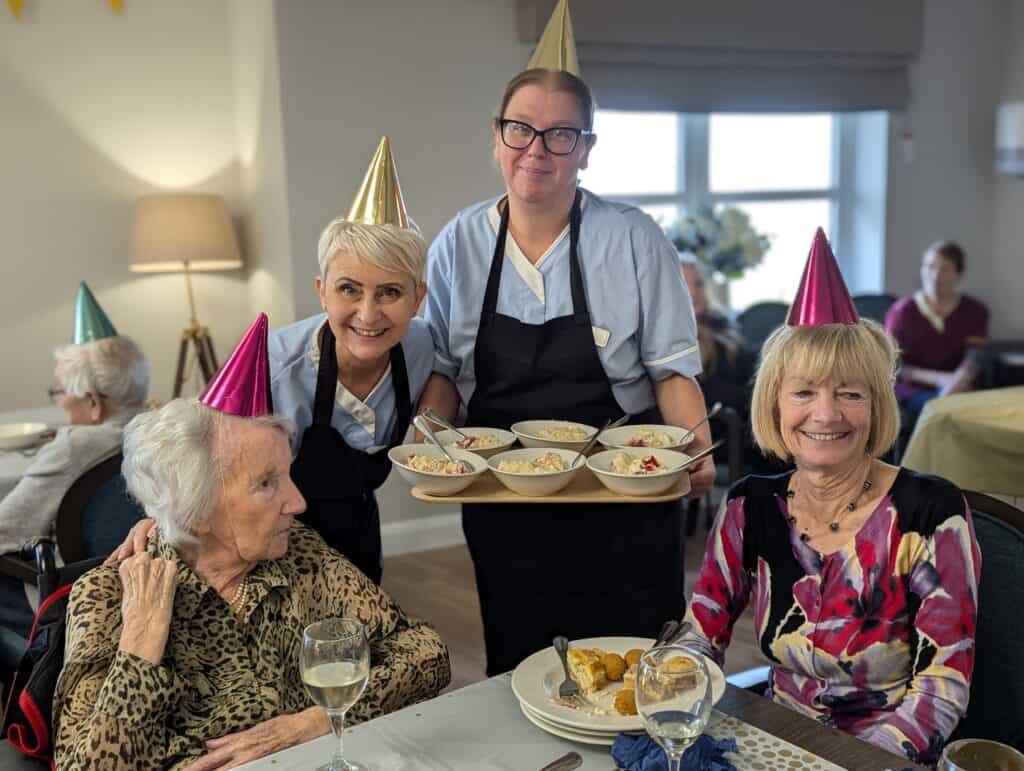
The DurhamGate Celebrate their First Anniversary
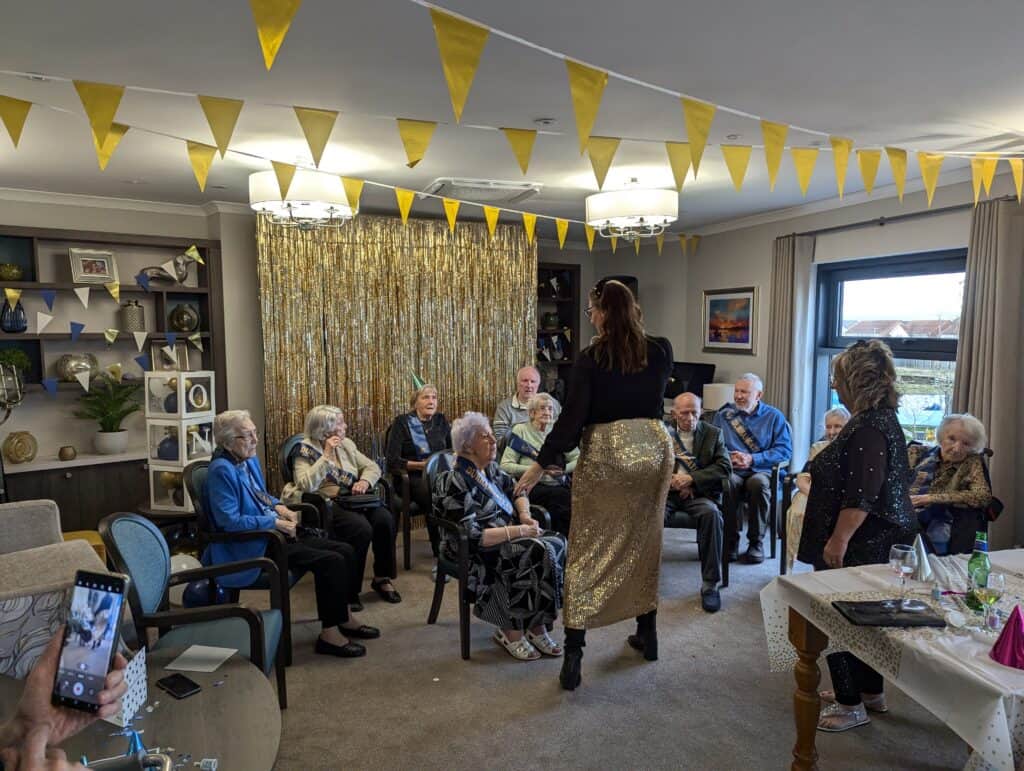
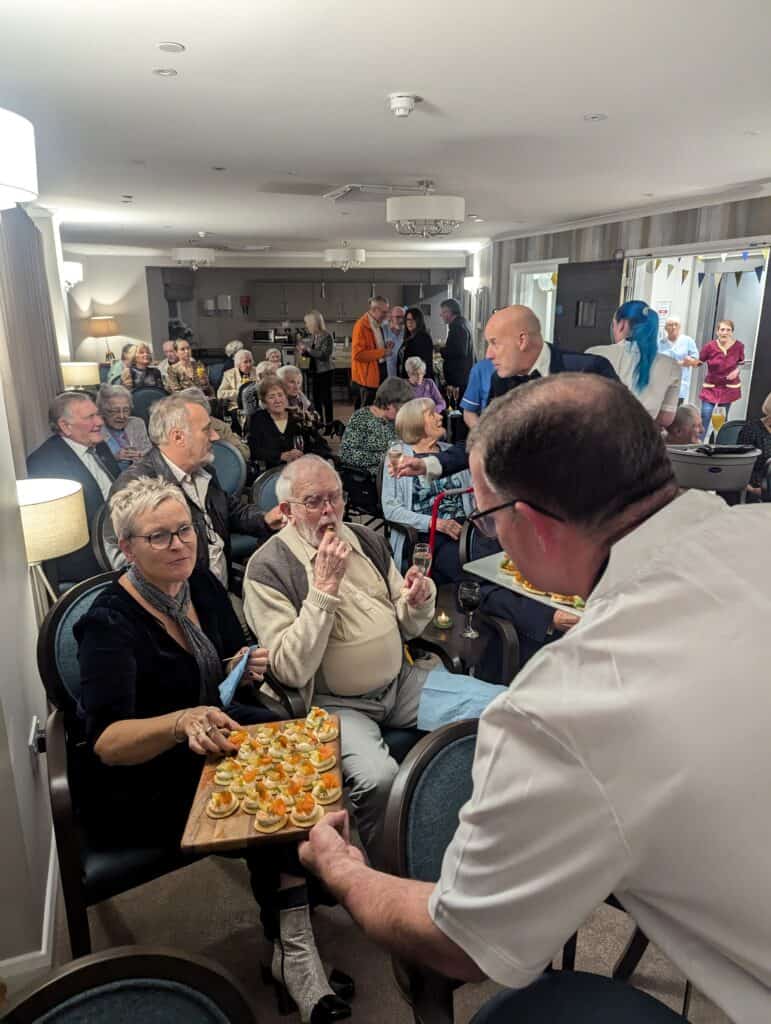
on News, Resident Stories, The DurhamGate, UncategorizedMarking a milestone, The DurhamGate Care Home Home in Spennymoor, County Durham, celebrated its one-year anniversary in style with a week of activities that delighted residents and staff, including a debut performance by the resident’s choir.
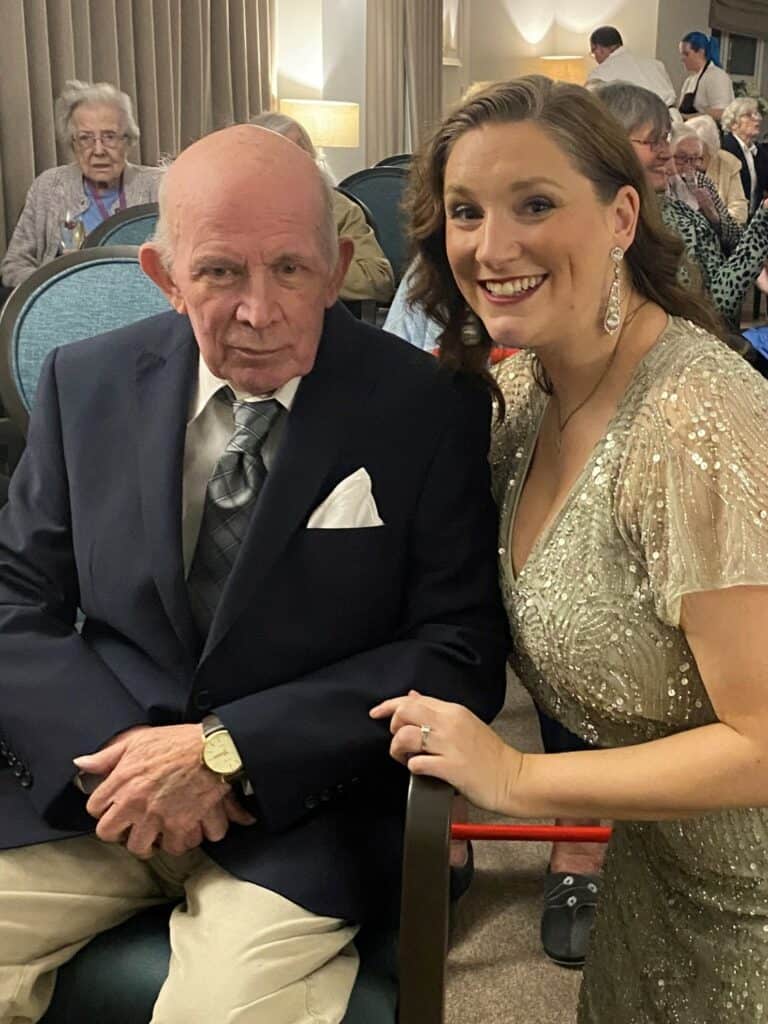
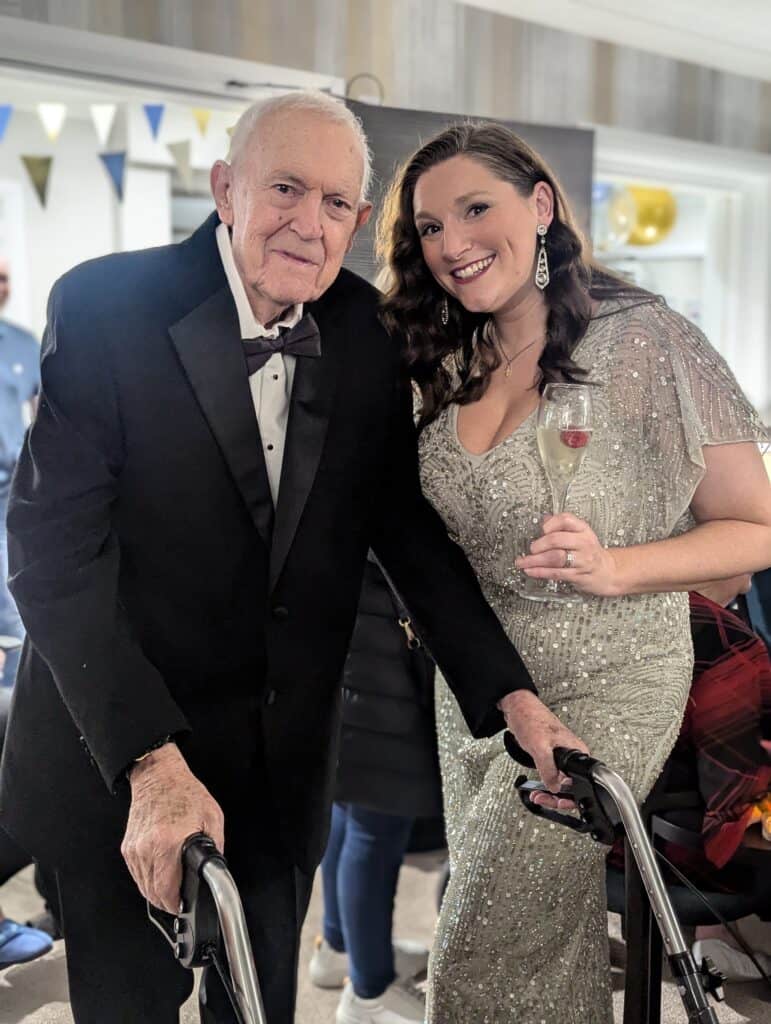
The festivities began with A Night at the Musicals. Residents dressed up for the event, enjoyed a drinks and canape reception, and were treated to a glamorous evening of musical songs performed by DurhamGate’s very own Front of House Manager, Samantha Holden.
Samantha commented, “It was such a special week of celebrations for our first birthday here at DurhamGate, and such a pleasure to surprise the residents with a special performance. Seeing the joy on everyone’s faces during A Night at the Musicals was truly heartwarming. This past year has been incredible, watching our community grow and thrive.”
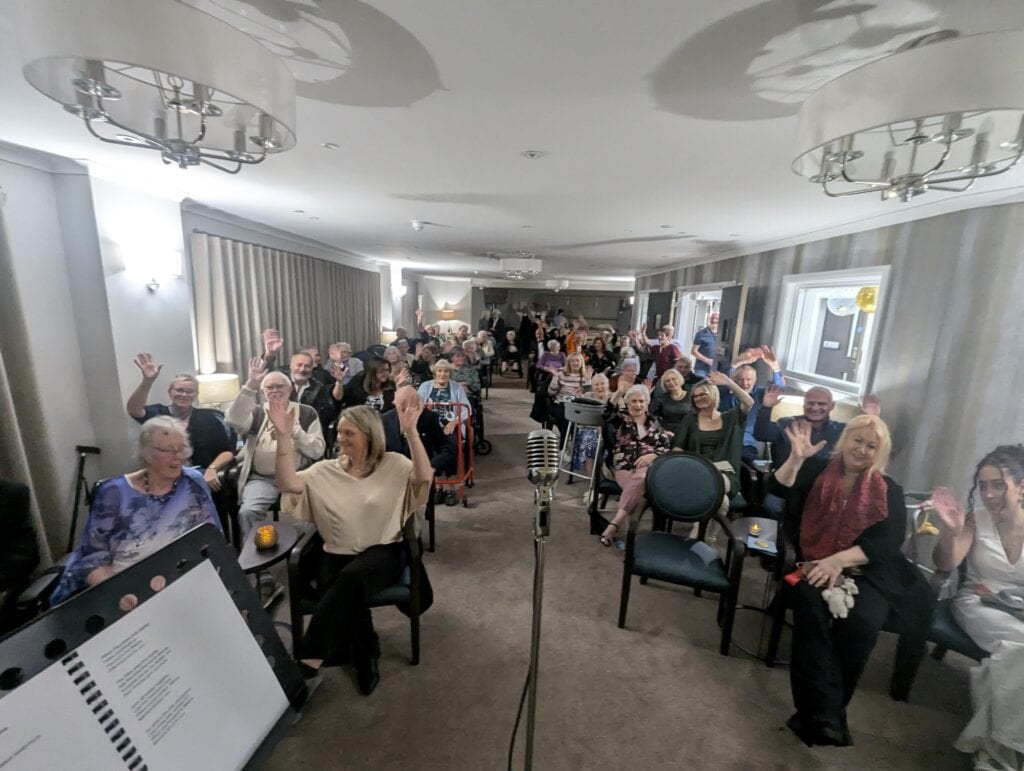
The highlight of the birthday celebrations was the debut performance of the resident’s choir.
Since September, ten talented residents at the care home have been rehearsing for the big event. Performing in front of fellow residents, families, friends, and staff, the choir delivered a selection of songs, including When You’re Smiling and Que Sera Sera. They were met with a warm reception, and their performance was followed by a roar of applause.
During the week, residents also enjoyed a nostalgic performance by Pete Johnson, who brought the magic of Rat Pack classics to life. As well as a special visit from Carrie Steele, whose repertoire of singalong favorites had everyone joining in.
Friends and families of the residents have taken to Facebook to express their appreciation for the team at DurhamGate Care Home, with one user commenting, “A great afternoon – thanks for all the hard work,” and another adding, “It was fab, everyone had the best time.”

Watch this fantastic video piece of our residents enjoying a fabulous day out on the Skipton canal boat trip through the beautiful North Yorkshire Countryside; chaperoned by our brilliant Lifestyle Manager, Elizabeth with Karen and Bev from Weavers Court.
https://drive.google.com/drive/folders/1WmTPXKRrlFp4A4aJVq_HMWRQlNQgsTAU?usp=drive_link
 August 9, 2024
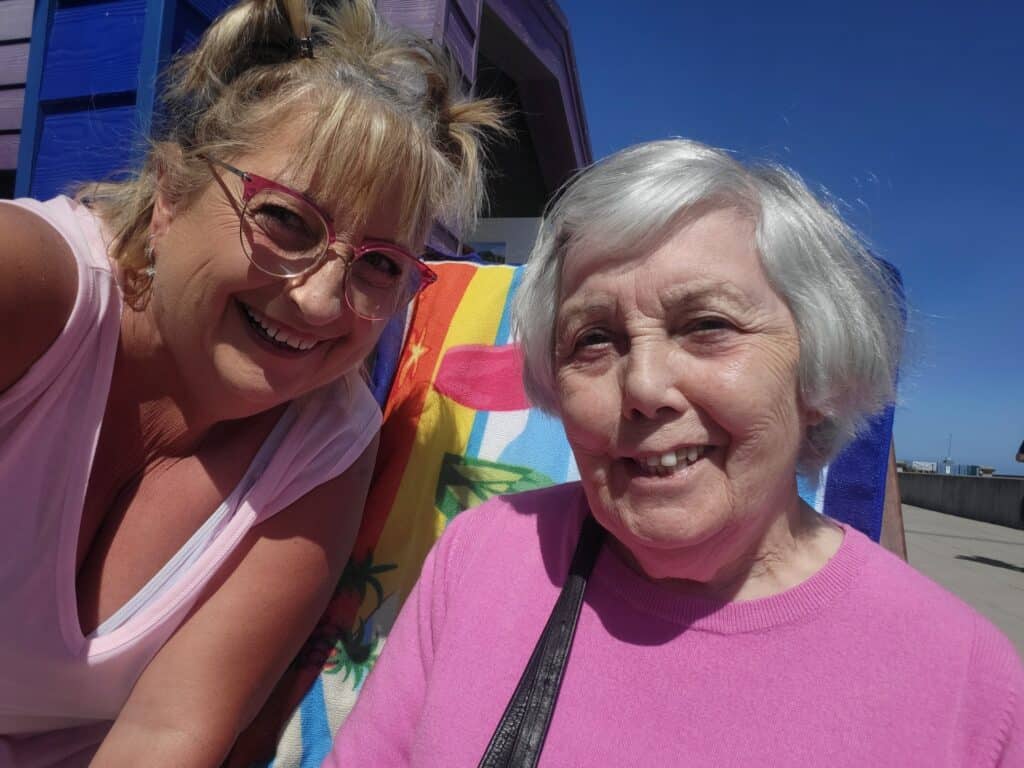
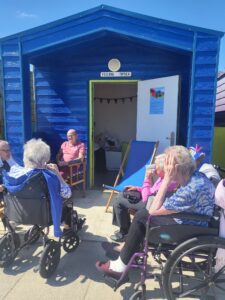
DurhamGate trip to the Seaside!
on Care Homes, News, Resident Stories, The DurhamGate


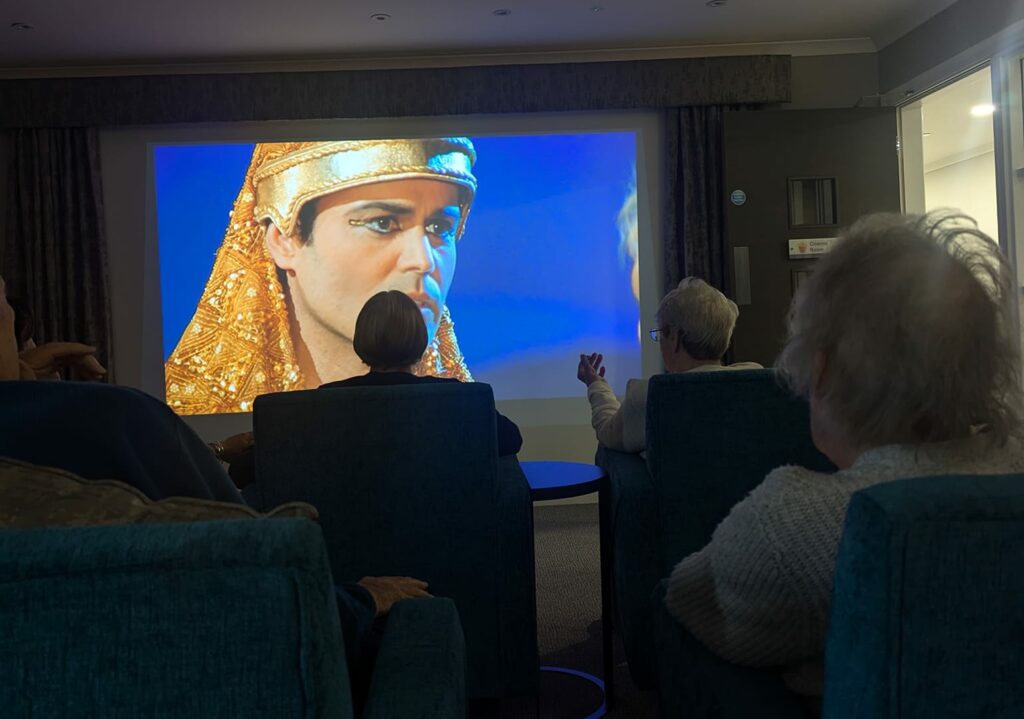

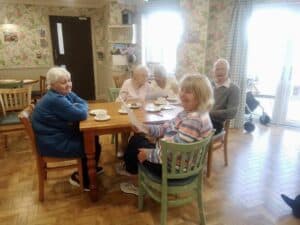
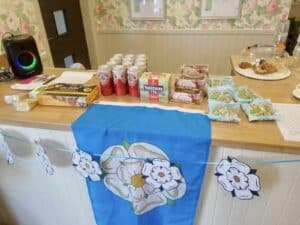
Residents of Leeds based Care Home, Weavers Court enjoyed celebrating all things Yorkshire on the 1st of August for Yorkshire Day.
They sampled lots of Yorkshire based produce as well as joining in with yorkshire quizzes and games.